Joint statement by Eastleigh Borough Council, Basingstoke and Deane Borough Council, Fareham Borough Council, Hart District Council, Havant Borough Council, Isle of Wight Council, New Forest District Council, Portsmouth City Council, Rushmoor Borough Council, Southampton City Council, Test Valley Borough Council and Winchester City Council.
Hampshire County Council has published its case for a future of only three, large-scale, councils across the county.
Their proposal risks creating remote, oversized councils, cut off from the places and people they serve. Our communities deserve better.
Here’s what the 12 councils working together across Hampshire, Southampton, Portsmouth and the Isle of Wight believe:
Local people should shape local decisions.
Making councils bigger makes it harder for residents to influence decisions that affect their daily lives, like school places, adult social care, housing and transport.
Biggest doesn’t mean best
Services like social care and special educational needs are already under pressure. Proposing three large councils won’t fix that.
The evidence shows that larger public authorities don’t guarantee better services, and they often feel more distant and harder to access for local people.
There’s a better way.
The councils working together across Hampshire and the Solent are putting forward proposals for five unitary authorities (four on the mainland and one; the Isle of Wight) that are:
- Large enough to succeed, with the capacity to deliver joined-up services and value for money.
- Small enough to care, rooted in real places and responsive to the communities they serve.
Smaller councils already prove this can work. They deliver high-performing services like waste collection, housing, and local regeneration.
They respond quickly to local needs, support diverse communities, and work closely with local businesses, schools and voluntary groups.
This isn’t theory, it’s how we work every day.
We already work together at scale when it makes sense; like through Project Integra, our long-standing waste partnership across Hampshire.
We collaborate to save money and improve services, without losing the local accountability and flexibility our communities value.
Local identity should count.
Real communities are shaped around sense of place and how people actually live, where they travel, learn, work and access services. This is why we are asking people to tell us about these things and share their views on our three options.
Crucially, Hampshire County Council’s own research shows people feel most connected to their immediate neighbourhoods, not large remote councils, and that many fear LGR will reduce their sense of local identity, weaken local representation, and make services harder to access.
For the services people rely on every day, like roads and travel, local understanding matters.
A single, county-wide approach can’t reflect the needs of such a diverse area. Our proposed model allows services to be designed and delivered around real communities, not a one-size-fits-all system.
Local democracy needs more than ‘token localism’
HCC’s plan for district area panels and locality teams within super-sized councils isn’t enough risks creating powerless talking shops. Communities need genuine decision-making power at neighbourhood level, with frontline councillors supported to lead and shape local priorities.
We are committed to creating councils that are simpler, stronger and more local, not just bigger. And we will continue working together to build a future that reflects the people and places of Hampshire and the Solent.
Councillor Jill Cleary, Leader of NFDC said: “We have made it clear that the option we support, in the best interests of our residents and businesses, is to align New Forest with similar communities and environments.
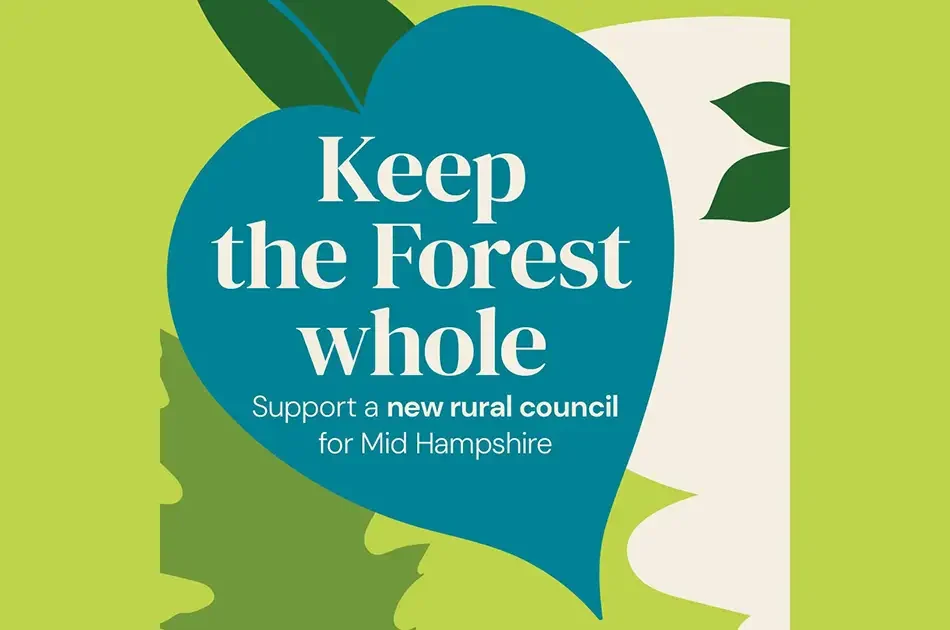
A new, rural council for mid-Hampshire.
That council make-up, with Test Valley, Winchester, and East Hampshire, is the natural fit for all four current districts.
This is Option 1 in the county-wide engagement, being supported by 12 councils working together.
The new council would be able to adopt a locally-focused delivery model, with services specifically designed for and around rural communities, as well as promote economic growth that is sustainable and respectful of the natural environment.
Our support for this option is entirely unchanged in light of Hampshire County Council’s proposed option.
“We remain steadfast in our opposition to all or any part of New Forest district being annexed to the Southampton – Eastleigh urban area.
This risks inappropriate, city-focused service provision and poorer services for existing new Forest residents forced into a city council area, an erosion & disregard of existing, deep community connections with rural life, and decisions that are not in the best interests of our precious environment.
“I restate my commitment to do all that I can to preserve what is special about our district now, to keep local services local, and to protect our balanced economy.
I will continue to oppose any option that splits our communities or aligns us with an urban sprawl.
I will always put the needs and wishes of residents first, and I encourage everyone in our district to complete the current survey newforest.gov.uk/lgr, which is critical to our submission to government, and to keep the Forest whole.”
Our Place Our Future:
Shaping council services in Hampshire, Southampton, Portsmouth and the Isle of Wight
The Government has asked councils across England to look at how local government is organised. A group of 12 of the 15 councils in Hampshire, Southampton, Portsmouth and the Isle of Wight are working together on options for reorganisation that build on what makes our communities unique – while making services efficient and future-proof.
Now we want to hear from you. What matters most to you and your area?
To complete the survey, use the link below, have your say by 27th July!